
As organizations grow or evolve, leadership decisions are guided by where time, attention, and investment are placed.
In many organizations—particularly those that are bottom-line focused and navigating significant change—the value of a senior marketing role may not surface as a near-term priority. Leadership teams managing new ownership structures, recent acquisitions, rapid growth, or profound market shifts are often focused on integration, continuity, and performance. In those moments, marketing leadership can feel less immediate than operational stability or revenue protection. This is a practical response to complexity.
What’s often overlooked is the opportunity cost. In my experience, when marketing leadership is absent, marketing work still moves forward—but it tends to operate baseline tactically rather than strategically. The organization misses the chance to use marketing as a lever to support pivots, unify newly combined teams, and clearly reposition products or services in a changing market.
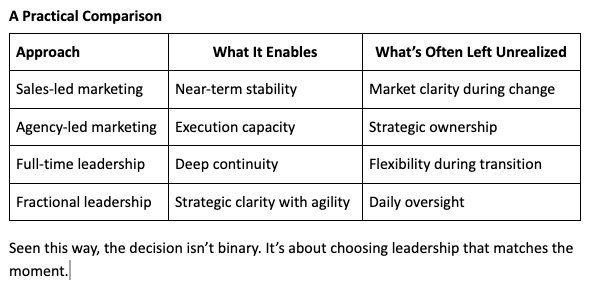
Within this article I offer a practical comparison of the most common approaches organizations take toward marketing leadership—and what each enables, or leaves unrealized, during periods of growth and transition.
The Most Common Paths Organizations Take
When senior marketing leadership is not in place, organizations typically move in one of three directions:
Sales-led marketing, where marketing functions primarily as a support service
Agency-led marketing, managed internally without experienced marketing leadership
Leadership-led marketing, through full-time or fractional senior ownership
Each approach produces activity. Only some produce clarity and alignment.
Sales-Led Marketing: Stability in the Short Term
During periods of rapid growth or transition, sales-led marketing can provide a sense of control. Marketing efforts are oriented around pipeline support, outbound execution, and near-term revenue goals.
I’ve seen this model work—particularly when organizations are under pressure to protect revenue during change. Over time, however, it narrows marketing’s role, nevermind that most strong sales people are not marketing people, but that’s another article.
Common characteristics include:
Messaging driven by immediate sales needs
Limited investment in positioning during market shifts
Marketing positioned as execution rather than strategic input
The opportunity left unrealized is marketing’s ability to translate change into clarity—for customers, employees, and the market.
Agency-Led Marketing Without Senior Oversight
Engaging a marketing agency is a common and often reasonable choice—especially during periods of growth or constrained internal capacity. I’ve managed many agency contracts, but in recent memory only two added holistic value for the engagement. The best results consistently came when there was continuity in the agency project leadership, particularly a stable project manager who developed deep familiarity with the business.
I’ve more frequently experienced the opposite. When project managers changed more than once, when the organization represented a smaller portion of an agency’s overall revenue, priorities sometimes shifted, or when the agency depended on vanity metrics to try to illustrate ROI. These dynamics are structural, not personal—and they matter.
Common challenges include:
Strategy shaped by vendor capabilities rather than business needs
Difficulty evaluating recommendations without senior oversight
Messaging fragmentation, particularly post-acquisition
Increasing dependence on external partners
There is also a fundamental limitation worth naming:
an agency will never be as close to the product, service, or customer as the organization itself.
Agencies bring valuable perspective, executional strength, and a level of task expertise, e.g.; understanding and managing the ever-changing structure of Google Ads. What they cannot fully replicate is day-to-day immersion—how customers actually buy, where friction shows up internally, or how change is experienced across teams.
In my experience, agencies do their best work when paired with experienced internal marketing leadership—someone who sets direction, maintains continuity, and ensures the work remains grounded in the organization’s evolving reality.
What Full-Time Marketing Leadership Enables
A full-time marketing leader provides embedded, continuous ownership of the function and is often the right choice once an organization has reached a more stable operating phase after change.
I’ve worked in organizations where this model worked exceptionally well—particularly once acquisitions were integrated, teams stabilized, and long-term growth strategies were clearly defined.
This approach works best for organizations that:
Require daily leadership and team development
Benefit from deep institutional knowledge
Are executing against a defined, multi-year plan
The tradeoff is commitment: higher fixed cost, longer ramp-up, and less flexibility if priorities continue to shift.
What Fractional Marketing Leadership Unlocks During Change
Fractional marketing leadership is particularly effective during periods of transition, when organizations need senior guidance without adding permanent structural weight.
In my work, fractional leadership has been most valuable when organizations:
Are navigating ownership changes or acquisitions
Need to clarify positioning after a pivot
Rely on agencies or internal teams but lack strategic alignment
Want to build the marketing function intentionally before hiring full-time
A fractional leader brings clarity, sets priorities, and establishes structure—ensuring marketing supports growth without becoming reactive.
Rather than competing with internal teams or agencies, fractional leadership creates coherence across them.
The Question That Brings Clarity
Instead of asking, “Is this the right time to add a senior marketing role?” leaders may find it more useful to ask:
“Is this the right moment to bring in marketing leadership—not just senior execution?”
In many organizations, the instinct is to hire a senior manager or director to manage activity while controlling costs. Those roles are essential, but they are designed to execute within an existing strategy—not to define one.
During periods of growth or change, what’s often missing isn’t capacity or experience, but clear ownership of direction.
Yes, leadership costs more. But in the short run, it is often more effective.
From what I’ve seen, a true marketing leader—fractional or full-time—can quickly establish clarity, prioritize effort, and reduce wasted spend far more effectively than layering execution onto an unclear foundation. Just as importantly, bringing in leadership relieves the rest of the executive team from carrying the burden of building the marketing muscle themselves—a responsibility that often falls to sales, product, or operations leaders by default.
When marketing leadership is in place, strategy no longer has to be debated, negotiated, or reinvented across functions. It is owned, stewarded, and translated into action—freeing leadership teams to focus where their attention is most critical.
The real question, then, is not whether the organization can afford leadership—but whether it can afford to continue distributing that responsibility across roles that were never meant to carry it.
CFO / CEO Takeaway:
Investing in true marketing leadership—fractional or full-time—often reduces short-term waste by clarifying strategy, improving agency efficiency, and removing the hidden cost of executive time spent filling a role the organization actually needs.
Choosing Leadership to Match the Moment
Marketing leadership is not defined by hours worked. It is defined by clarity of direction, accountability, and integration.
Organizations experiencing growth, change, or transition are often best served by leadership models that match their moment—not ones that add unnecessary rigidity.
When marketing leadership is aligned to reality, it becomes not an added cost, but a stabilizing and enabling force.
